You grab your favorite jacket before heading out the door. As you reach one arm backward to slide it into the sleeve, a sharp pain shoots through your shoulder.
Maybe you have to put your painful arm into the jacket first. Perhaps you've started asking someone to help you get dressed, or you've changed how you put on your coat to avoid that uncomfortable movement.
For many adults over 50, something as simple as putting on a jacket can become surprisingly difficult.
If your shoulder hurts when putting on a coat or jacket, the problem may involve rotator cuff irritation, shoulder osteoarthritis, frozen shoulder, or inflammation in the surrounding tissues.
Understanding why this everyday movement causes discomfort can help you recognize when an evaluation may be appropriate.
Your shoulder is one of the most mobile joints in your body.
Unlike the hip, which has a relatively deep ball-and-socket structure, the shoulder sacrifices some inherent stability to allow a much greater range of motion.
Putting on a jacket requires several coordinated movements:
When arthritis, tendon degeneration, or restricted shoulder mobility is present, these movements can become painful.
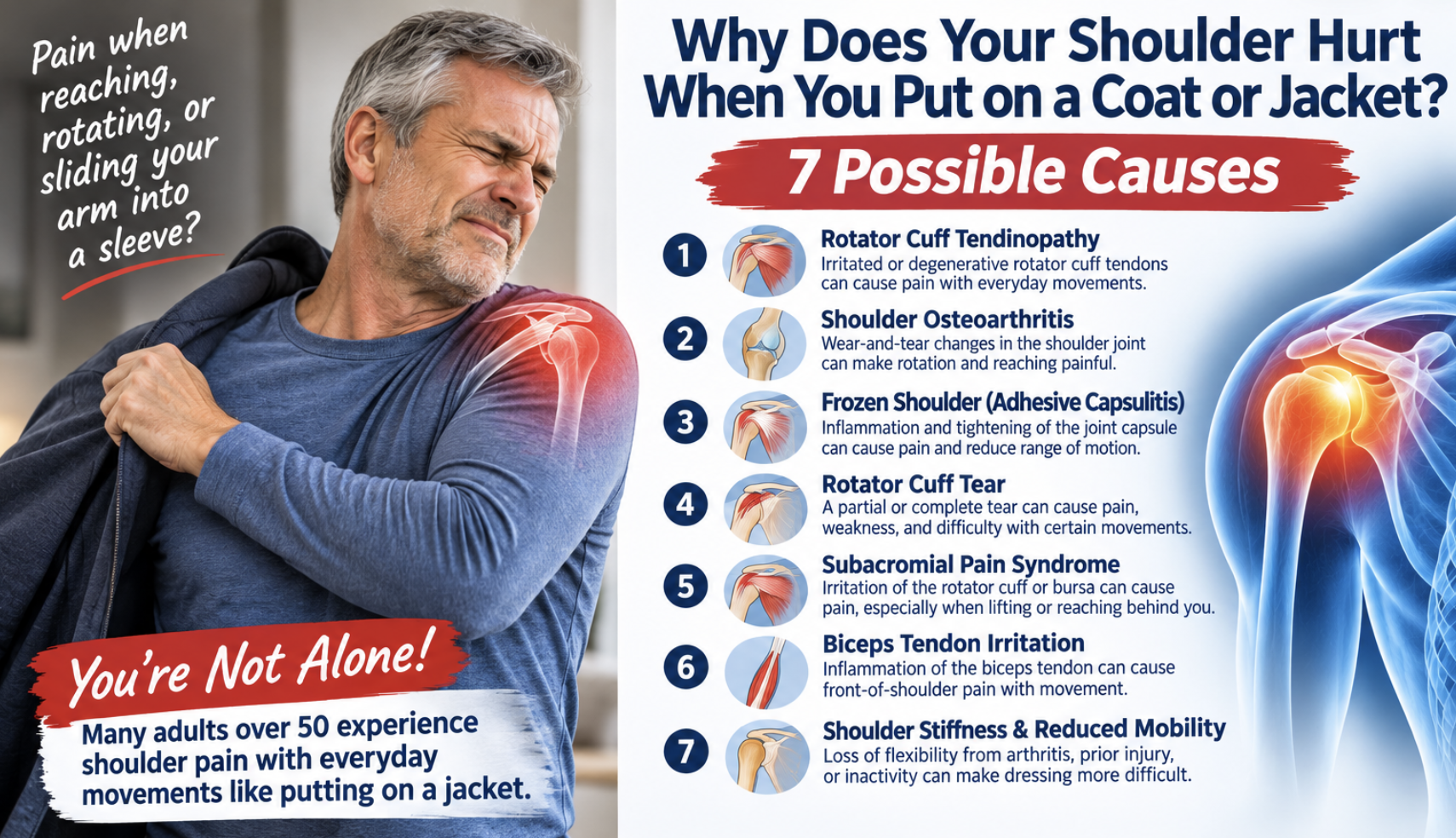
Here are seven possible explanations.
Rotator cuff tendinopathy is one of the most common causes of shoulder pain among middle-aged and older adults.
The rotator cuff consists of four muscles and their tendons that help stabilize and move the shoulder.
These include the supraspinatus, infraspinatus, teres minor, and subscapularis.
Over time, rotator cuff tendons may develop degenerative changes associated with aging, repetitive loading, or previous injuries.
When you reach backward to put on a jacket, these tendons help control the position of the humeral head within the shoulder socket.
If the tendons are irritated or degenerative, the movement may cause discomfort.
Common symptoms include:
Rotator cuff tendinopathy does not necessarily mean a tendon is torn.
Many patients improve with appropriately selected exercise-based treatment and activity modification.
Shoulder osteoarthritis occurs when degenerative changes affect the glenohumeral joint, where the humeral head articulates with the glenoid of the scapula.
As cartilage deteriorates and other joint structures change, shoulder movement may become increasingly uncomfortable.
Patients with shoulder osteoarthritis often experience stiffness, reduced range of motion, deep joint pain, and grinding sensations.
Putting on a coat can be particularly challenging because the movement requires shoulder rotation.
Some individuals notice they can raise their arm forward reasonably well but struggle when reaching behind their body.
Others experience pain during nearly every attempt to rotate the shoulder.
Although shoulder osteoarthritis becomes more common with age, not every patient with degenerative changes experiences severe symptoms.
The degree of discomfort and functional limitation varies considerably.
Frozen shoulder, medically known as adhesive capsulitis, involves progressive pain and restriction of shoulder movement.
The condition affects the shoulder joint capsule, which becomes inflamed and develops fibrotic changes.
Unlike some tendon conditions, frozen shoulder typically restricts both active movement and passive movement when someone else attempts to move your arm.
One of the most characteristic findings is reduced external rotation.
This can make putting on a coat, reaching into the back seat of a vehicle, or fastening clothing especially difficult.
Frozen shoulder often progresses through overlapping phases involving pain, stiffness, and gradual recovery.
The course can last many months and sometimes longer.
People with diabetes and certain thyroid disorders have an increased risk of developing adhesive capsulitis.
Treatment depends on the stage and severity of the condition and may include physical therapy, pain management, and selected injections.
Rotator cuff tears become increasingly common with age.
Some occur following an injury, while others develop gradually through degenerative changes.
Importantly, not every rotator cuff tear causes symptoms.
However, symptomatic tears may produce pain, weakness, and difficulty performing everyday activities.
Putting on a jacket can be particularly challenging when the affected tendons cannot adequately control shoulder movement.
Patients may notice pain when lifting their arm, difficulty reaching backward, weakness when holding objects, or discomfort at night.
A sudden injury followed by significant weakness or inability to lift the arm warrants prompt evaluation.
For degenerative tears, treatment decisions depend on the size of the tear, symptoms, functional limitations, and the patient's goals.
Many individuals can initially pursue non-surgical management, although some tears benefit from surgical evaluation.
Subacromial pain syndrome is a term used to describe shoulder pain associated with structures around the rotator cuff and subacromial space.
It may involve rotator cuff tendinopathy, irritation of the subacromial bursa, or altered shoulder loading.
The condition commonly causes pain when lifting the arm or performing certain reaching movements.
Some patients experience a painful arc as the arm moves through a particular range.
Reaching behind the body to slide an arm into a jacket sleeve may aggravate these sensitive structures.
Symptoms can overlap considerably with rotator cuff tendinopathy.
A clinical examination can help identify which movements reproduce the pain and guide appropriate treatment.
The long head of the biceps tendon travels through the front of the shoulder and attaches near the superior glenoid.
This tendon can become irritated or develop degenerative changes, particularly in individuals with other shoulder conditions.
Biceps tendinopathy often causes discomfort toward the front of the shoulder.
Pain may become more noticeable when lifting objects, reaching backward, or performing movements that load the tendon.
For some individuals, putting on a jacket creates enough shoulder extension to aggravate the affected area.
Biceps tendon problems frequently occur alongside rotator cuff disorders rather than as an isolated condition.
Treatment depends on the underlying diagnosis and may involve activity modification and progressive rehabilitation.
Sometimes the main problem is not a single injured structure but a gradual reduction in shoulder mobility.
This can develop because of osteoarthritis, previous injuries, prolonged inactivity, or other conditions affecting the joint and surrounding tissues.
For example, someone who has avoided painful shoulder movements for several months may gradually lose flexibility and strength.
As a result, reaching behind the body becomes increasingly difficult.
Putting on a jacket may eventually require compensatory movements involving the neck, trunk, or opposite shoulder.
Persistent loss of mobility should be evaluated to distinguish general movement restrictions from conditions such as adhesive capsulitis or advanced osteoarthritis.
The location of your pain may offer clues about the structures involved.
Pain location
Possible contributing conditions
Front of shoulder
Biceps tendinopathy, rotator cuff disorders
Outside of shoulder or upper arm
Rotator cuff tendinopathy, subacromial pain syndrome
Deep inside the shoulder
Glenohumeral osteoarthritis, adhesive capsulitis
Back of shoulder
Posterior soft-tissue irritation, joint disorders
Shoulder pain with significant stiffness
Frozen shoulder, shoulder osteoarthritis
Pain location alone cannot establish a diagnosis because several shoulder conditions produce overlapping symptoms.
Many individuals who experience shoulder pain while dressing also notice discomfort when lying in bed.
This is particularly common with rotator cuff disorders and shoulder osteoarthritis.
Lying directly on the affected shoulder may increase pressure on sensitive tissues.
Certain sleeping positions may also place the shoulder in uncomfortable degrees of rotation.
Some patients find that supporting the arm with a pillow helps reduce nighttime discomfort.
However, persistent night pain, particularly when accompanied by weakness or reduced mobility, should be evaluated.
Several practical adjustments may help reduce shoulder stress during dressing.
When putting on a jacket, try placing the affected arm into its sleeve before the unaffected arm.
This allows you to use your more comfortable shoulder to complete much of the movement.
When removing the jacket, take the unaffected arm out first.
This technique may reduce the amount of painful rotation required.
If reaching backward produces sharp discomfort, avoid repeatedly forcing the movement.
Instead, bring the jacket around your body in a way that minimizes painful shoulder extension.
Loose-fitting jackets, front-opening garments, and clothing with flexible sleeves may be easier to manage.
Tight jackets can require greater shoulder rotation and may aggravate symptoms.
Appropriate range-of-motion exercises can help maintain flexibility.
However, the correct exercises depend on the underlying condition.
For example, an individual with adhesive capsulitis may require a different rehabilitation approach than someone with a symptomatic rotator cuff tear.
Avoid aggressive stretching that significantly increases pain.
Progressive strengthening of the rotator cuff and scapular stabilizers can improve function in many individuals with shoulder disorders.
Exercises should be tailored to the patient's symptoms, strength, and movement limitations.
Occasional shoulder discomfort may resolve with temporary activity modification.
However, recurring pain when putting on clothing can indicate an underlying condition requiring evaluation.
Consider scheduling an appointment if you experience persistent shoulder pain, difficulty reaching behind your back, increasing stiffness, weakness when lifting your arm, or discomfort that regularly interferes with sleep.
Seek urgent medical care for shoulder pain associated with chest pressure, shortness of breath, or other symptoms suggesting a cardiac emergency.
Prompt evaluation is also important after a significant injury, particularly if you cannot lift your arm or notice deformity, severe swelling, or new neurological symptoms.
Not necessarily.
Many shoulder conditions can initially be managed without surgery.
Depending on the diagnosis, treatment may include physical therapy, progressive strengthening, activity modification, medications, and selected injection-based treatments.
For individuals with shoulder osteoarthritis, conservative care may help manage symptoms and maintain function.
However, no non-surgical intervention can reliably regenerate cartilage lost through advanced osteoarthritis.
Shoulder replacement surgery may be appropriate for selected patients with advanced symptomatic joint degeneration who continue experiencing substantial limitations despite conservative treatment.
Similarly, some rotator cuff tears require surgical evaluation, particularly when associated with significant weakness or acute traumatic injury.
An individualized examination can help determine which options are appropriate.
If shoulder pain makes it difficult to put on a jacket, reach into cabinets, wash your hair, or sleep comfortably, it may be time to explore your options.
At Arthritis & Joint Pain Center, we help appropriate patients experiencing chronic shoulder pain and osteoarthritis understand their condition and explore individualized non-surgical treatment options.
Whether your symptoms have recently developed or you've been dealing with shoulder discomfort for years, an evaluation may help clarify the next steps.
Don't assume that struggling to put on a coat is simply part of getting older. Understanding what's causing your shoulder pain is an important step toward making informed decisions about your care.