You're enjoying a walk through your neighborhood, taking a stroll through the park, or walking down a gentle hill on your property.
Walking uphill doesn't seem too bad. Walking on level ground is manageable.
But as soon as you start heading downhill, your knee begins to hurt.
Maybe you feel a sharp pain around your kneecap. Perhaps there's an aching sensation along the inside of your knee, or you notice that your knee feels unstable with every downward step.
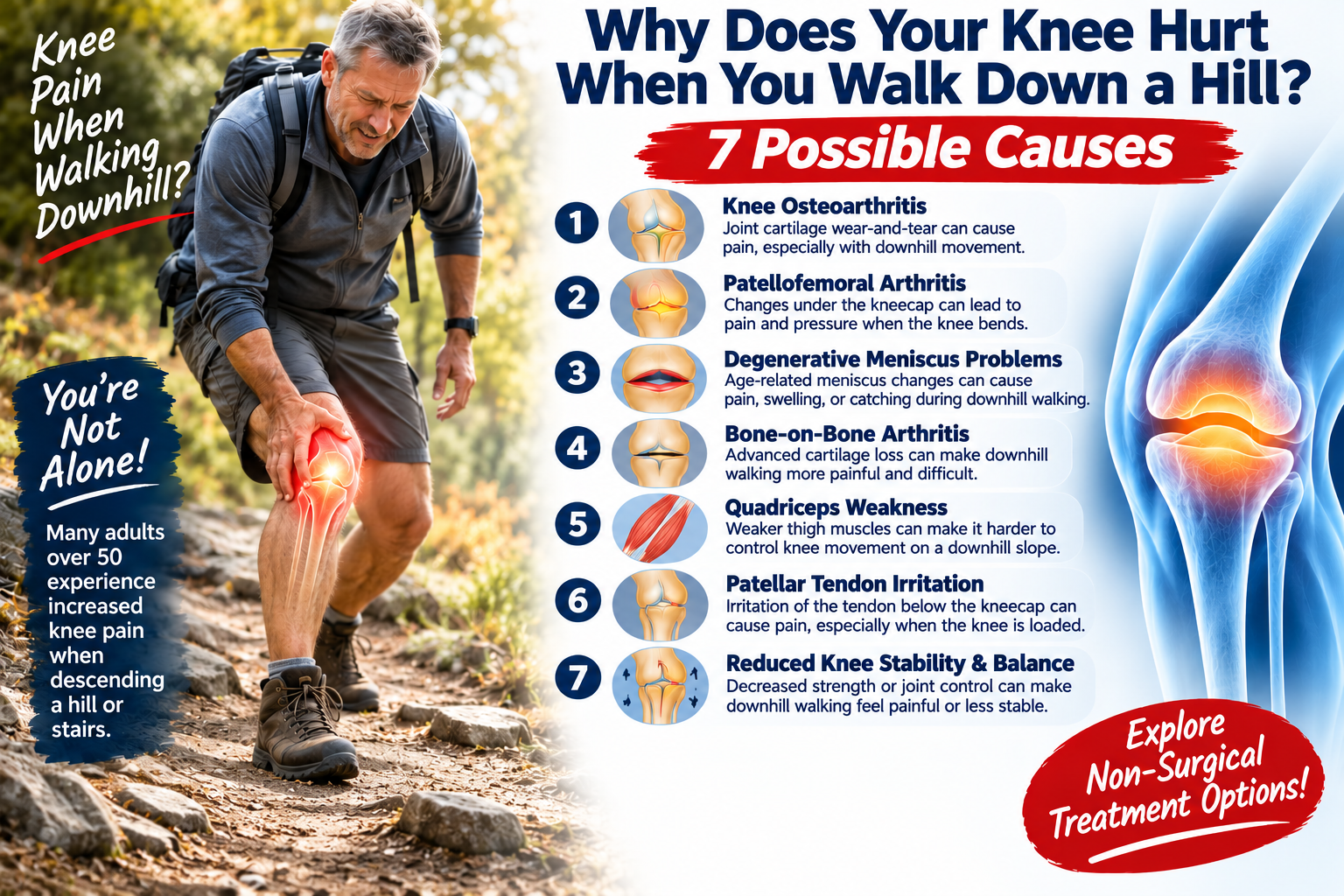
If your knee hurts when walking downhill, the problem may involve osteoarthritis, cartilage degeneration, patellofemoral joint stress, meniscus irritation, or weakness in the muscles that control your knee.
This is a common complaint among adults over 50, particularly those experiencing degenerative joint conditions.
Understanding why downhill walking causes discomfort can help you determine when an evaluation may be appropriate.
Walking downhill places different mechanical demands on the knee than walking on level ground.
When descending a slope, your quadriceps muscles work eccentrically. This means they generate force while lengthening to control the bending of your knee and prevent your body from dropping too quickly.
At the same time, the knee must absorb and control the forces associated with each step.
Downhill walking often involves greater knee flexion and increased loading of the patellofemoral joint, where the kneecap articulates with the femur.
These mechanical demands can aggravate an already sensitive knee.
For individuals with arthritis, meniscus degeneration, or reduced muscle strength, descending a hill may become considerably more uncomfortable than walking uphill.
Here are seven possible explanations.
Knee osteoarthritis is one of the most common causes of pain during downhill walking, particularly among older adults.
Osteoarthritis involves degenerative changes affecting the articular cartilage, subchondral bone, synovium, and other joint structures.
As these changes progress, the knee may become more sensitive to weight-bearing activities.
Walking downhill requires repeated knee bending under load, which can aggravate symptoms.
Common signs of knee osteoarthritis include:
Some patients experience relatively mild symptoms on flat surfaces but develop substantial discomfort when descending slopes.
This difference often reflects the greater muscular and joint-loading demands of downhill walking.
The patellofemoral joint is located between the kneecap and the femur.
As your knee bends, the patella moves within the trochlear groove of the femur.
This movement helps the quadriceps efficiently extend the knee.
However, the patellofemoral joint experiences substantial compressive forces during activities involving knee flexion under load.
Walking downhill is one of these activities.
When cartilage degeneration affects the underside of the kneecap or the corresponding femoral surface, patients may experience pain toward the front of the knee.
Common symptoms of patellofemoral arthritis include:
Some individuals notice that walking uphill is easier because their movement pattern and joint-loading demands differ.
However, the relationship varies with slope, speed, and individual biomechanics.
The menisci are two crescent-shaped fibrocartilaginous structures located between the femur and tibia.
Their primary functions include load distribution, shock absorption, and joint stability.
As people age, degenerative changes can develop within the menisci, sometimes without a specific injury.
When walking downhill, the knee repeatedly bends while supporting body weight.
These movements may aggravate a symptomatic degenerative meniscus.
Patients may notice pain along the inside or outside of the knee, intermittent swelling, catching sensations, or discomfort when changing direction.
However, meniscus abnormalities are common on imaging in older adults and do not always explain knee pain.
Many degenerative meniscus conditions can initially be managed conservatively through appropriate strengthening and rehabilitation.
Some individuals with advanced osteoarthritis are told they have bone-on-bone arthritis.
This term generally refers to severe joint-space narrowing associated with substantial cartilage loss.
When advanced degenerative changes are present, the knee may have reduced tolerance for repetitive loading.
Walking downhill can be especially uncomfortable because the knee must repeatedly control body weight as it bends.
Patients may experience deep aching, sharp discomfort, stiffness, swelling, or reduced confidence when descending slopes.
However, the degree of cartilage loss seen on an X-ray does not always correspond directly with symptom severity.
A diagnosis of bone-on-bone arthritis does not automatically mean immediate knee replacement surgery is required.
Treatment decisions should consider the patient's pain, functional limitations, medical history, and response to appropriate conservative care.
Your quadriceps muscles play an essential role in controlling knee movement during downhill walking.
When descending a slope, the quadriceps must generate eccentric force to control knee flexion.
If these muscles are weak, the task may become more difficult.
People with chronic knee pain sometimes reduce their activity levels to avoid discomfort.
Unfortunately, reduced activity can contribute to progressive quadriceps weakness.
This may create a cycle in which knee pain limits activity, muscle strength declines, and downhill walking becomes increasingly uncomfortable.
Appropriate resistance training can improve strength and function in many individuals with knee osteoarthritis.
Exercises may include modified sit-to-stands, controlled step-downs, and other movements selected according to the patient's tolerance.
The goal is to improve the muscles' ability to control knee loading without excessively aggravating symptoms.
The patellar tendon connects the kneecap to the tibial tuberosity.
It plays an important role in transmitting force from the quadriceps muscles to the lower leg.
Patellar tendinopathy is more commonly associated with jumping and athletic activities, but tendon-related pain can also occur in older adults.
Walking downhill increases the demand on the knee extensor mechanism.
When the patellar tendon is irritated, this may cause discomfort just below the kneecap.
Symptoms can include localized tenderness, pain during loaded knee bending, and discomfort when descending stairs or slopes.
Patellar tendon pain differs from typical osteoarthritis because it is often more localized to the tendon rather than deep within the joint.
A clinical examination can help distinguish between these conditions.
Not all downhill knee discomfort is caused by cartilage or tendon problems.
Reduced balance, impaired proprioception, muscle weakness, or previous ligament injuries may also contribute.
Proprioception is the body's ability to sense joint position and movement.
When walking downhill, your nervous system must continuously coordinate muscle activity to maintain balance and control each step.
Individuals with chronic knee arthritis may develop changes in strength, joint-position awareness, and movement patterns.
Some begin taking shorter steps, keeping their knees relatively stiff, or leaning backward because they are concerned about falling.
These compensations may increase discomfort or reduce confidence.
Balance training, strengthening, and appropriate gait strategies may help improve function.
The location of your pain can provide clues about which structures may be involved.
Pain location
Possible contributing conditions
Front of knee or behind kneecap
Patellofemoral arthritis, patellofemoral pain
Inside of knee
Medial compartment osteoarthritis, medial meniscus degeneration
Outside of knee
Lateral compartment arthritis, lateral meniscus problems
Just below kneecap
Patellar tendon irritation
Deep throughout the knee
Osteoarthritis or another intra-articular condition
Pain with instability or giving way
Muscle weakness, ligament problems, or pain-related inhibition
Pain location alone cannot establish a diagnosis because several conditions can produce overlapping symptoms.
Many people assume that walking uphill should be harder on their knees because it requires more physical effort.
However, the two activities place different demands on the body.
Walking uphill requires the muscles to generate force to propel the body upward.
Walking downhill requires the muscles to control the body's descent.
This braking action increases the importance of eccentric quadriceps control.
Depending on slope and walking mechanics, downhill walking can also increase patellofemoral joint loading.
For individuals with patellofemoral arthritis, this may explain why descending a hill or staircase is particularly painful.
However, uphill walking can also aggravate certain knee conditions. The pattern of pain depends on the affected structures and individual movement mechanics.
Several practical strategies may help reduce discomfort.
Long downhill strides can increase the braking demands placed on your legs.
Taking shorter, controlled steps may help reduce abrupt loading.
Avoid rushing downhill, particularly on uneven surfaces.
Walking quickly downhill increases the need to control momentum.
A slower pace may make the movement more manageable.
Appropriate quadriceps strengthening can improve knee control.
Exercises should be selected according to your symptoms and physical abilities.
For individuals with osteoarthritis, progressive strengthening is an important component of conservative management.
Trekking poles may improve stability and help distribute some of the demands of walking across the upper body.
They can be particularly useful on uneven terrain.
However, proper technique and appropriately adjusted pole height are important.
Shoes with adequate traction and appropriate support may improve confidence when descending slopes.
Worn or slippery footwear can increase the risk of falls.
If downhill walking consistently produces significant pain, temporarily choosing flatter routes may help manage symptoms.
The goal is to maintain appropriate activity while avoiding repeated aggravation.
Occasional discomfort after a long walk does not necessarily indicate a serious joint problem.
However, recurring pain when walking downhill may suggest an underlying condition that deserves evaluation.
Consider scheduling an appointment if you experience persistent knee pain, repeated swelling, difficulty descending stairs, reduced walking tolerance, or increasing instability.
Seek prompt medical attention if your knee becomes acutely swollen, red, or hot, particularly with fever, or if you cannot bear weight following an injury.
These symptoms may indicate conditions requiring more urgent evaluation.
Not necessarily.
Many individuals with knee osteoarthritis, including some with advanced degenerative changes, can explore non-surgical management before considering joint replacement.
Depending on the diagnosis, treatment may include therapeutic exercise, physical therapy, weight management when appropriate, activity modification, medications, and selected injection-based treatments.
The effectiveness of individual treatments varies.
Non-surgical care cannot reliably restore cartilage lost through advanced osteoarthritis or guarantee that knee replacement will be avoided.
For patients with severe, persistent pain and substantial functional limitations despite appropriate conservative management, knee replacement surgery may be a reasonable option.
An individualized evaluation can help determine which approach best matches the patient's condition and goals.
If knee pain makes it difficult to walk downhill, descend stairs, enjoy outdoor activities, or move comfortably throughout the day, it may be time to explore your options.
At Arthritis & Joint Pain Center, we help appropriate patients experiencing chronic knee pain and osteoarthritis understand their condition and explore individualized non-surgical treatment options.
Whether you've recently developed knee discomfort or have been living with arthritis for years, an evaluation may help clarify your next steps.
Don't assume that knee pain when walking downhill is simply part of getting older. Understanding the cause is the first step toward making informed decisions about managing your symptoms and maintaining mobility.