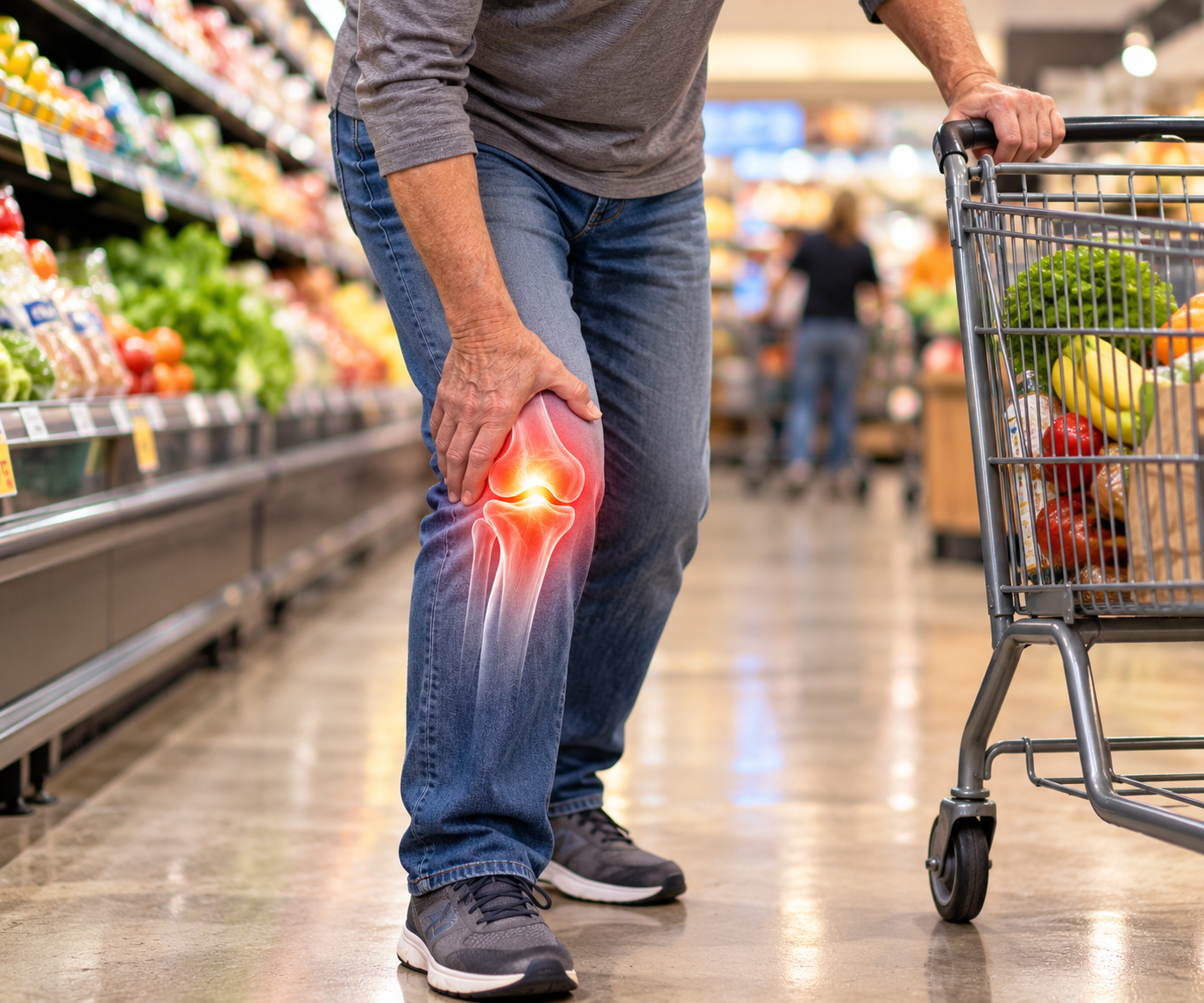
You're heading into the grocery store to pick up a few things.
At first, everything feels pretty good.
You grab a shopping cart, walk down the first couple of aisles, and start checking items off your list.
But about 10 or 15 minutes later, your knee begins to ache. 🦵😣
Maybe you notice discomfort along the inside of your knee.
Perhaps your knee starts feeling stiff or swollen.
Or you find yourself leaning more heavily on the shopping cart because walking is becoming uncomfortable.
By the time you reach the checkout, you're ready to sit down!
Sound familiar?
For many adults dealing with knee arthritis or chronic joint pain, grocery shopping can become surprisingly challenging.
And there are several reasons why.
Walking places repeated loads through your knees.
With every step, your knee joints help support your body weight while the surrounding muscles control movement.
For someone with a healthy knee, this process usually occurs without much discomfort.
But if you have knee osteoarthritis, irritated joint tissues, or reduced muscle strength, repeated walking may gradually aggravate symptoms.
You might notice a pattern:
🛒 The first few minutes feel relatively comfortable.
🚶 After several aisles, your knee begins aching.
🦵 Your leg starts feeling tired or heavy.
😣 You begin shortening your steps.
🪑 Sitting down provides some relief.
The fact that your knee doesn't hurt immediately doesn't mean there isn't an underlying problem.
Sometimes symptoms become noticeable only after the joint has been loaded repeatedly.
Osteoarthritis is one of the most common causes of chronic knee pain in adults over 50.
It involves changes affecting the cartilage, underlying bone, and other structures within the joint.
As the condition progresses, people may experience pain, stiffness, swelling, and reduced mobility.
One common complaint is difficulty walking for extended periods.
You may be able to walk from your house to your car without much trouble.
But walking around a grocery store for 20 or 30 minutes may be considerably more uncomfortable.
Symptoms can include:
Interestingly, the severity of arthritis seen on an X-ray doesn't always correspond directly with how much pain someone experiences.
Some people with advanced joint degeneration remain relatively active, while others with less severe changes experience significant limitations.
Have you noticed that pushing a shopping cart makes walking easier?
There are several possible explanations.
A shopping cart provides some upper-body support and can help with balance.
It may also encourage you to walk at a slower, more controlled pace.
For individuals with painful knees, these changes can sometimes make walking more comfortable.
However, there's another important consideration.
If leaning forward over a shopping cart consistently relieves pain, heaviness, or numbness in your legs, the problem may involve your lower back rather than your knee alone.
This pattern is sometimes associated with lumbar spinal stenosis.
Spinal stenosis involves narrowing around nerves in the lower back.
Some individuals experience symptoms during standing or walking that improve when they sit or bend forward.
This is commonly called the shopping cart sign.
So, while knee arthritis may explain pain during grocery shopping, symptoms that improve dramatically with forward bending deserve a broader evaluation.
Your quadriceps are the large muscles on the front of your thighs.
They play an important role in supporting and controlling your knees during walking.
When these muscles are weak or have reduced endurance, longer periods of activity may become more challenging.
You might notice:
💪 Your legs feel increasingly tired.
🦵 Your knee begins feeling less stable.
🚶 Your walking pace slows down.
⚖️ You start shifting more weight onto your stronger leg.
😣 Your knee discomfort increases as you continue shopping.
Muscle weakness can develop with aging, inactivity, chronic pain, and knee osteoarthritis.
Pain and swelling within the knee can also interfere with normal quadriceps activation, a phenomenon known as arthrogenic muscle inhibition.
This can contribute to reduced strength and altered walking mechanics.
Appropriate strengthening exercises may improve walking tolerance for many people with knee osteoarthritis.
Grocery shopping isn't just walking.
You frequently stop to compare prices, read labels, or decide what to purchase.
Sometimes you stand in the same position for several minutes.
For individuals with knee arthritis, prolonged standing can become uncomfortable.
The knee continues supporting body weight, even though you're not moving.
Some people find that gentle movement feels better than remaining stationary.
Others experience discomfort when they begin walking again after standing still.
You may notice:
🛒 Pain while waiting in the checkout line
🦵 Stiffness after standing in one aisle
🚶 Discomfort during your first few steps
🔴 A gradual increase in aching
🪑 Relief after sitting down
The pattern of symptoms can help identify which activities are aggravating the joint.
Most grocery stores have hard flooring.
While these surfaces are generally level and easy to walk on, they provide little cushioning.
For someone with chronic knee pain, walking and standing on hard floors for extended periods may feel uncomfortable.
Footwear can also influence how walking feels.
Shoes that are worn out, poorly fitted, or lacking appropriate support may contribute to discomfort.
However, there isn't one specific shoe that's best for everyone with knee arthritis.
Foot structure, gait mechanics, comfort, and individual needs all matter.
Supportive, well-fitting footwear may help some individuals tolerate longer shopping trips more comfortably.
Some people notice that their knee feels relatively normal when they enter the store.
But after shopping, it becomes tight, stiff, or visibly swollen.
This may reflect irritation within the joint.
Knee osteoarthritis can be associated with episodes of synovitis, which involves inflammation of the joint lining.
The joint may also produce excess synovial fluid, contributing to an effusion.
You might experience:
💧 A feeling of fullness around the knee
🦵 Difficulty bending comfortably
🔴 Aching after activity
🪑 Stiffness after sitting in the car
🚶 Pain when getting out of the vehicle
Recurring swelling is worth evaluating, particularly when it is accompanied by increasing pain or reduced mobility.
Sometimes the discomfort doesn't peak while you're shopping.
Instead, you finish your errands, drive home, and sit down to rest.
Then, when you stand up again, your knee feels stiff and painful.
This pattern may involve both activity-related irritation and start-up pain.
Start-up pain refers to discomfort that occurs when movement resumes after a period of inactivity.
It is commonly reported by individuals with osteoarthritis.
You might notice that:
Although this pattern can occur with arthritis, other knee conditions may produce similar symptoms.
One of the frustrating aspects of chronic knee pain is how gradually it can affect independence.
Maybe you used to enjoy walking through the store and picking out your own groceries.
Now you plan shorter trips.
Perhaps you avoid larger stores because you know your knee won't tolerate the walking.
Or you've started asking someone else to shop for you.
Some people begin using grocery pickup or delivery—not because they prefer it, but because walking through the store has become too uncomfortable.
When knee pain starts changing how you manage everyday responsibilities, it's worth paying attention to.
Pain severity matters, but so does the effect on your daily life.
A few practical adjustments may help reduce discomfort.
If walking for 30 minutes consistently aggravates your knee, consider shorter trips when practical.
Choose footwear that fits well and feels stable during walking.
A cart may provide useful support, but avoid relying on an unstable cart if you have significant balance problems.
If symptoms begin increasing, consider sitting for a few minutes rather than pushing through worsening pain.
Use a cart to transport groceries and divide heavy loads into smaller bags.
Quadriceps and hip strengthening may improve function and walking tolerance for some individuals.
Repeated swelling after routine activities may indicate ongoing joint irritation that deserves evaluation.
These adjustments may make shopping easier, but they don't replace identifying the underlying cause of persistent knee pain.
No.
Difficulty walking through a grocery store doesn't automatically mean knee replacement surgery is necessary.
Several factors can contribute to activity-related knee pain, including:
Depending on the diagnosis, non-surgical management may include therapeutic exercise, physical therapy, activity modification, medications, appropriate bracing, or selected injection-based treatments.
For individuals with advanced symptomatic knee osteoarthritis who continue experiencing substantial pain and functional limitations despite appropriate conservative care, knee replacement may be a reasonable consideration.
However, the need for surgery should be determined through individualized evaluation rather than one symptom or activity limitation alone.
Consider an evaluation if you're experiencing:
🚩 Increasing difficulty walking through stores
🚩 Persistent knee pain during everyday activities
🚩 Recurrent swelling
🚩 Difficulty standing in checkout lines
🚩 Knee buckling or instability
🚩 Reduced walking distance
🚩 Increasing reliance on shopping carts for support
🚩 Avoiding activities because of knee pain
Seek prompt medical attention for sudden inability to bear weight, significant swelling following an injury, or a hot, red, painful knee accompanied by fever.
If your knee starts hurting after walking through a grocery store, there may be more going on than simple fatigue.
Knee arthritis, muscle weakness, joint irritation, and other conditions can contribute to reduced walking tolerance.
And while shorter shopping trips or supportive footwear may help temporarily, persistent knee pain that interferes with everyday activities deserves attention.
At Arthritis & Joint Pain Center, we help appropriate patients with chronic knee pain understand what's contributing to their symptoms and explore non-surgical treatment options, with the goal of reducing pain and improving mobility.
Because maintaining your independence includes being able to handle everyday errands without constantly worrying about your knees.