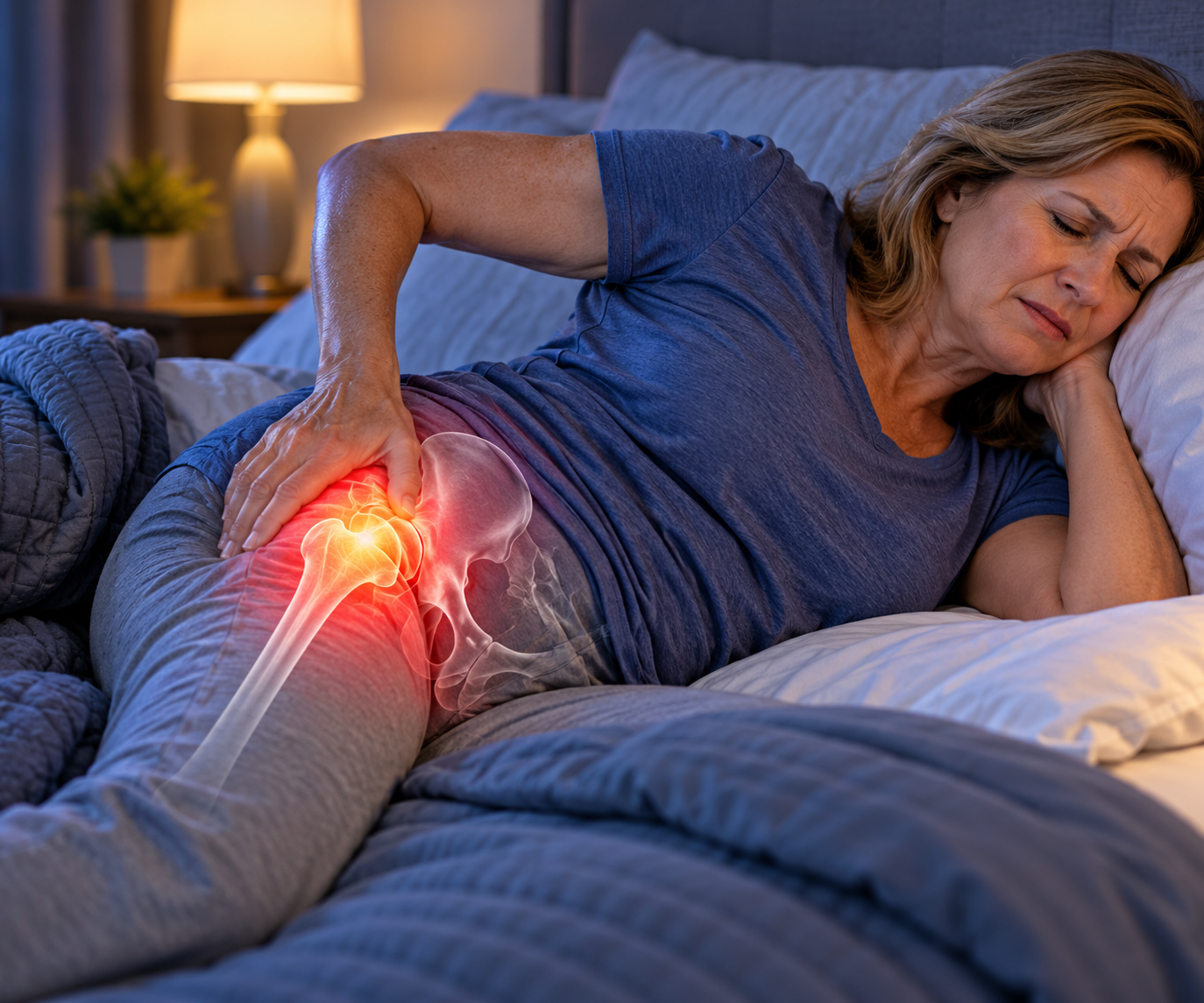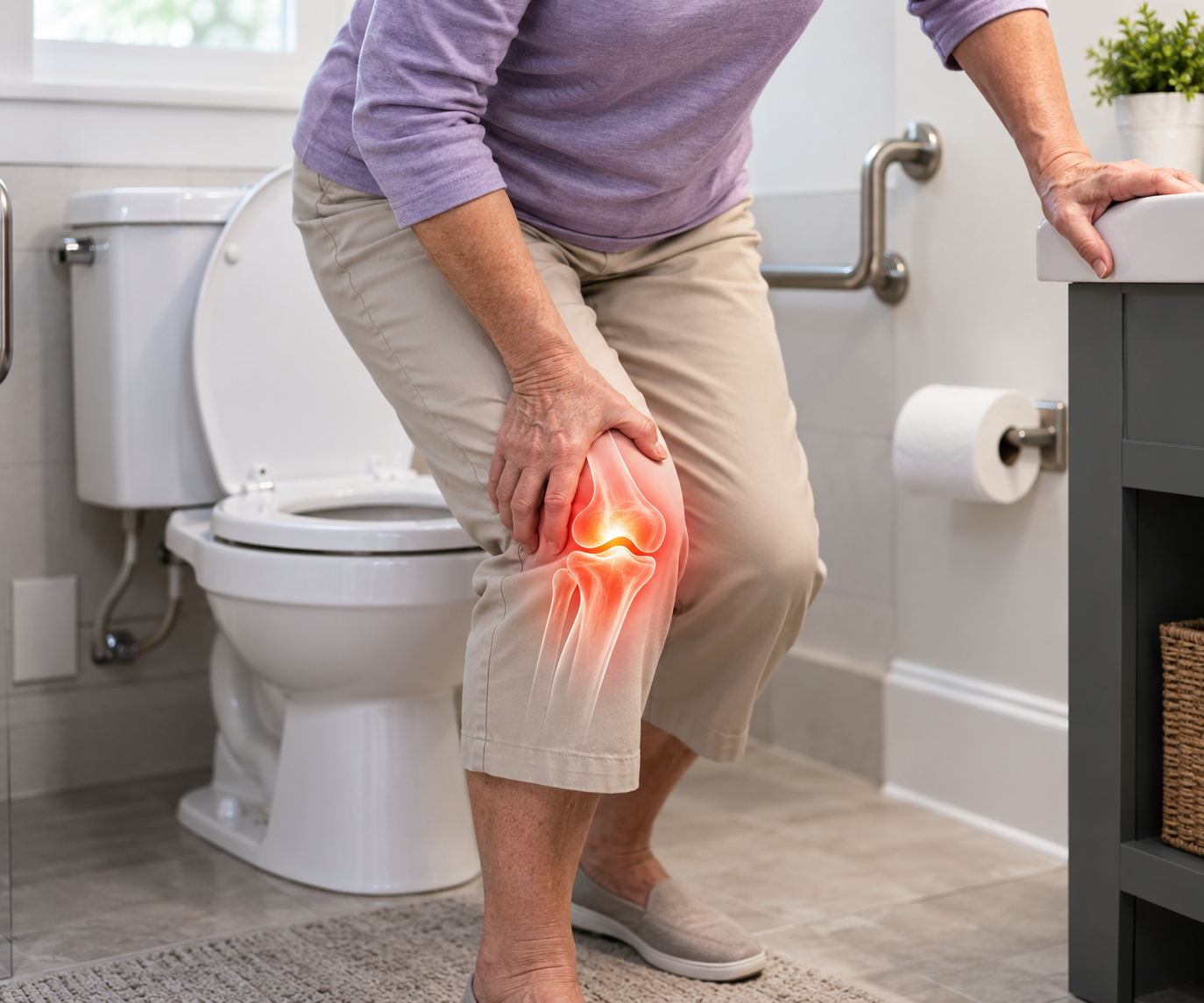
You're sitting in the bathroom, and everything feels fine.
But when it's time to stand up, your knee suddenly starts hurting! 🦵😣
Maybe you have to push yourself up using the sink or countertop.
Perhaps you lean forward, grab onto something, or put most of your weight on your stronger leg.
Or maybe you've noticed that getting up from a low toilet has become much more difficult than standing up from your favorite chair.
Sound familiar?
For many adults dealing with knee arthritis, muscle weakness, or chronic joint pain, getting up from the toilet can be one of the most uncomfortable activities of the day.
And there's a reason this seemingly simple movement can place considerable demands on your knees.
Standing up from a seated position requires your knees, hips, and surrounding muscles to work together.
But not all seats are created equal.
A standard toilet is often lower than many household chairs, which means your knees may be bent more deeply when you're sitting.
The lower the seat, the greater the muscular effort generally required to stand up.
When you rise from the toilet, several things happen:
🦵 Your quadriceps contract to straighten your knees.
🦴 Your knee joints support increasing body weight.
💪 Your hip muscles help lift your body.
⚖️ Your center of gravity shifts forward.
↗️ Your knees move from a deeply bent position toward standing.
If your knees are already arthritic, stiff, or painful, this combination can make standing up particularly uncomfortable.
Osteoarthritis is one of the most common causes of chronic knee pain in older adults.
It involves changes affecting the cartilage, underlying bone, and other tissues within the joint.
As osteoarthritis progresses, certain weight-bearing movements may become increasingly uncomfortable.
Standing from a low toilet can be especially challenging because the knee must generate force while moving through a relatively large range of motion.
You may notice:
Interestingly, you may be able to walk across the room with relatively little discomfort but experience significant pain when getting up from the toilet.
That's because walking and standing from a low seat place different demands on the knee.
Your quadriceps are the large muscles on the front of your thighs.
They play a major role in straightening your knees and helping you rise from a seated position.
When these muscles are weak, standing up becomes more difficult.
You might notice yourself:
🪑 Rocking forward several times before standing
🤚 Pushing off with both hands
🦵 Favoring one leg
😣 Struggling to rise without assistance
🚶 Taking a few moments to steady yourself after standing
Muscle weakness can develop for several reasons, including inactivity, aging, chronic pain, and knee arthritis.
There's another important factor.
Pain and swelling within the knee can interfere with normal quadriceps activation.
This phenomenon, known as arthrogenic muscle inhibition, can make the quadriceps function less effectively even when the muscle itself hasn't suffered a direct injury.
As a result, some people experience a combination of pain, weakness, and difficulty standing.
The patellofemoral joint is where your kneecap, or patella, articulates with the femur.
This joint plays an important role during knee bending and straightening.
As your knee bends more deeply, the forces acting across the patellofemoral joint generally increase during weight-bearing activities.
For individuals with patellofemoral osteoarthritis or other kneecap-related conditions, standing from a low seat can trigger discomfort.
You may experience:
🔴 Pain directly behind the kneecap
🦵 Aching across the front of the knee
🪜 Difficulty climbing stairs
🪑 Pain when rising from chairs
🔊 Grinding or crackling sensations
Sometimes patients describe this as a sharp pain in the front of the knee when they begin standing.
Others experience a deep ache that gradually improves once they're upright.
Some people notice that the first movement after sitting is the most uncomfortable.
They may experience pain when initially standing, followed by improvement after taking several steps.
This is sometimes described as start-up pain.
It is frequently reported by individuals with osteoarthritis.
During periods of inactivity, the joint may feel stiff, and the surrounding muscles may require time to resume comfortable movement.
When you begin moving again, symptoms may temporarily improve.
You might notice this pattern:
However, start-up pain isn't exclusive to arthritis.
Other knee conditions can produce similar symptoms.
Think about the difference between sitting in a tall dining chair and sitting on a low couch.
Getting up from the taller chair is usually easier.
The same principle applies to toilet height.
When you're sitting lower, your hips and knees generally begin in a more flexed position.
To stand, your muscles must generate enough force to lift your body through a greater vertical distance.
This places increased demands on the quadriceps and hip extensors.
For someone with painful knee arthritis, the difference of just a few inches in seat height may be noticeable.
That's why some individuals find that an elevated toilet seat makes standing considerably more comfortable.
It's common for knee arthritis to affect one knee more severely than the other.
When standing up, you may unconsciously shift your weight toward your stronger leg.
This can temporarily reduce discomfort in the painful knee.
But over time, you might notice that you're increasingly relying on one side.
Perhaps you:
↔️ Lean heavily toward one leg
🤚 Push off the sink or countertop
🦵 Keep your painful knee slightly forward
😣 Avoid bending the affected knee deeply
⚖️ Feel unsteady while standing
These compensations can be useful clues during a clinical evaluation.
However, persistent difficulty bearing weight or repeated knee buckling should not simply be attributed to arthritis without further assessment.
Yes, in some cases.
The menisci are fibrocartilaginous structures within the knee that help distribute loads across the joint.
Degenerative meniscus changes become increasingly common with age and frequently coexist with osteoarthritis.
When the knee is deeply bent, certain movements may aggravate an irritated meniscus.
You might experience:
However, not every painful movement from a seated position indicates a meniscus tear.
And degenerative meniscus findings on an MRI aren't always the source of a patient's symptoms.
A clinical evaluation helps distinguish between possible causes.
Have you ever watched someone rock forward several times before getting out of a chair?
There's a biomechanical reason for that movement.
To rise from sitting, your body's center of mass must move forward over your feet before you can effectively stand.
Leaning forward helps position your body for the transition.
If your legs are weak or your knees are painful, you may need additional momentum to get upright.
However, excessive rocking or difficulty standing without using your hands can indicate reduced lower-extremity strength or functional limitations.
If you're increasingly struggling to stand from a seated position, it's worth investigating why.
A few practical adjustments may help reduce knee discomfort.
Increasing the height of the toilet seat can reduce the amount of knee bending required to stand.
For some individuals, even a modest increase in height makes a noticeable difference.
Properly installed grab bars can provide additional support and improve bathroom safety.
Avoid relying on towel racks or unstable fixtures.
Placing your feet beneath or slightly behind your knees, as comfort and balance allow, can help prepare you to stand.
A controlled forward lean can help shift your center of mass over your feet.
Appropriate quadriceps and hip strengthening exercises may improve your ability to rise from a seated position.
Exercises should be tailored to your symptoms and physical abilities.
Try to stand fully before turning rather than combining rising with a twisting movement.
If discomfort continues or worsens, identifying the underlying cause may help guide appropriate treatment.
No.
Difficulty standing from a low toilet doesn't automatically mean knee replacement surgery is necessary.
Several factors can contribute, including:
Depending on the diagnosis, non-surgical management may include physical therapy, strengthening exercises, activity modifications, appropriate medications, bracing, or selected injection-based treatments.
For individuals with advanced symptomatic knee arthritis who continue experiencing substantial pain and disability despite appropriate conservative treatment, knee replacement may be a reasonable consideration.
But difficulty rising from a toilet, by itself, doesn't establish the need for surgery.
Consider an evaluation if you're experiencing:
🚩 Increasing difficulty standing from chairs or toilets
🚩 Persistent knee pain with weight-bearing
🚩 Repeated knee buckling
🚩 Recurring swelling
🚩 Reduced knee range of motion
🚩 Difficulty climbing stairs
🚩 Increasing reliance on your arms to stand
🚩 Fear of falling during everyday activities
Seek prompt medical attention if you develop sudden inability to bear weight, significant swelling following an injury, or a hot, red, painful knee accompanied by fever.
If your knees hurt when you stand up from the toilet, the problem may involve more than simple stiffness.
Knee arthritis, reduced quadriceps strength, kneecap-related problems, and other conditions can make this everyday movement surprisingly difficult.
And while a raised toilet seat or grab bars may provide practical relief, persistent knee pain that interferes with basic daily activities deserves attention.
At Arthritis & Joint Pain Center, we help appropriate patients with chronic knee pain understand what's contributing to their symptoms and explore non-surgical treatment options, with the goal of reducing pain and improving mobility.
Because maintaining independence often starts with being able to perform the simplest everyday activities comfortably.