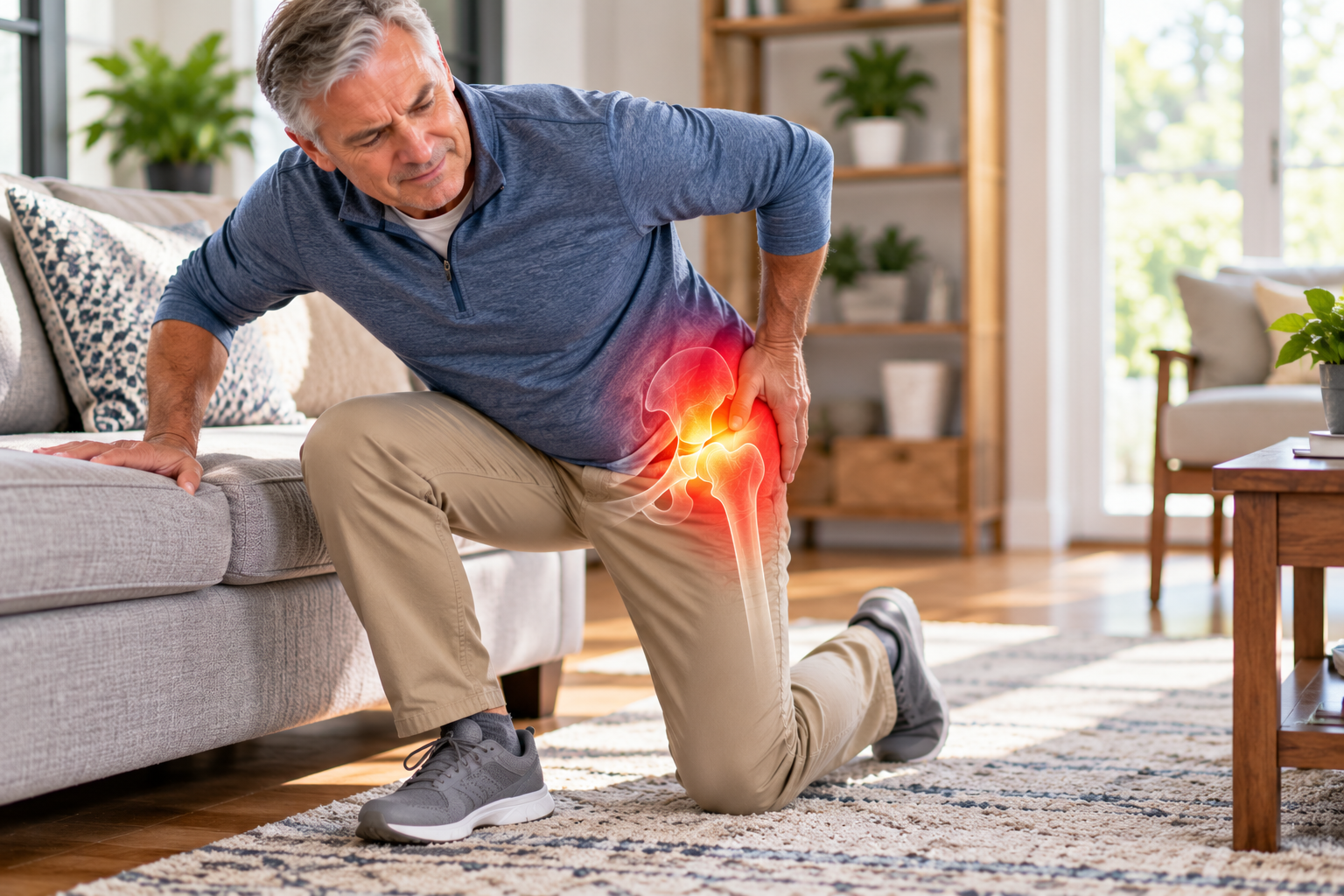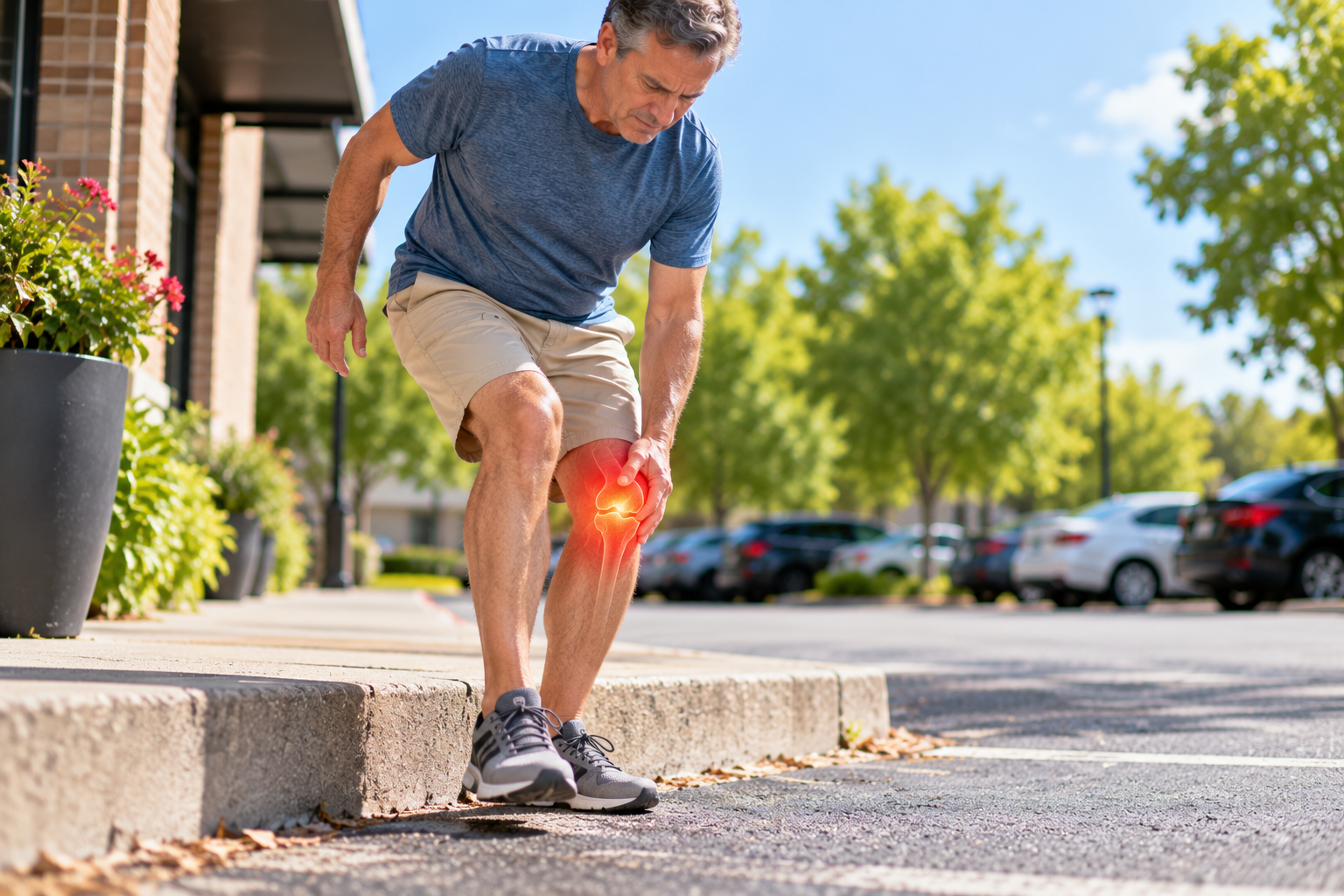
You’re walking through a parking lot feeling pretty good.
Then you step off the curb and—
OUCH. 🦵😣
That single step down sends pain through your knee.
Maybe it happens stepping off a sidewalk, coming down from a porch, or taking the last step on a staircase.
Interestingly, you may have little trouble stepping UP onto the curb.
So why can stepping down hurt so much more?
When you step down from a curb, gravity is pulling your body toward the ground.
Your supporting leg has to control that descent.
Instead of simply pushing your body upward, the muscles in your thigh, particularly your quadriceps, have to slowly control your body as your knee bends.
Think of them as brakes.
If your knee is already painful, stiff or weak, controlling that downward movement can become uncomfortable.
The kneecap, or patella, moves along a groove at the end of your thigh bone as your knee bends and straightens.
When you lower yourself from a curb, the knee bends while supporting much of your body weight.
That can increase forces around the kneecap.
People with irritation in this area may notice pain when:
🪜 Going downstairs
⬇️ Walking downhill
🪑 Lowering themselves into a chair
🏃 Slowing down after walking quickly
🚗 Stepping down from a taller vehicle
If those activities all bother the same knee, the pattern can provide useful information.
Knee arthritis is another common contributor.
Arthritis may cause pain, stiffness, swelling and reduced range of motion.
But symptoms aren't always constant.
You might walk reasonably well across a flat parking lot and then experience a sharp increase in discomfort when you reach the curb.
That's because different activities place different demands on the knee.
Walking comfortably on level ground doesn't necessarily mean the knee will tolerate stepping downward just as well.
Your quadriceps are extremely important when you're lowering your body.
If those muscles become weaker, your knee may have less muscular support when stepping down.
Sometimes this happens because knee pain has gradually caused someone to become less active.
You walk less.
Avoid stairs.
Stop exercising.
Use the stronger leg whenever possible.
Over time, the painful leg can become weaker—which may make stepping down even more difficult.
Pay attention the next time you approach a curb.
You may have developed a strategy without realizing it.
Perhaps you:
👉 Always step down with the painful leg first
👉 Keep the stronger leg on the curb to control your descent
👉 Reach for a railing whenever possible
👉 Turn slightly sideways
👉 Take an unusually short step
👉 Look for a ramp instead
Your body is very good at finding ways around painful movements.
Those compensations aren't necessarily bad, especially when they improve safety.
But they can reveal how much your knee is affecting everyday function.
The final stair can sometimes be surprisingly uncomfortable.
Unlike the other stairs, where the height is predictable, stepping onto a floor or sidewalk may require your body to adjust slightly differently.
The same thing happens with curbs.
If you're distracted, carrying groceries or misjudge the height, your knee suddenly has to absorb and control more of your body weight than expected.
For someone with an irritated knee, that can produce a sharp reminder that something isn't working comfortably.
Possibly.
Meniscus problems can cause knee pain during weight-bearing movements, particularly when bending or rotating the knee.
You may also notice:
But pain stepping off a curb doesn't automatically mean you have a torn meniscus.
Arthritis, kneecap irritation, muscle weakness and other conditions can produce similar symptoms.
If stepping down hurts, don't rush it.
Look at the curb before stepping and use a railing or other stable support when available.
Taking a slightly shorter, controlled step may be easier than dropping quickly onto the lower leg.
Appropriate strengthening of the muscles around the knee can also be helpful for some people.
And if you're carrying bags or other objects, remember that the additional weight can increase the demand on your knee.
Most importantly, don't repeatedly force a movement that causes sharp pain simply because you think you should be able to do it.
No.
Pain stepping off a curb doesn't automatically mean your knee arthritis is severe enough for replacement surgery.
Arthritis, kneecap problems, meniscus irritation, stiffness and muscle weakness can all contribute.
An evaluation should consider your symptoms, strength, mobility, swelling, imaging when appropriate, and how much your knee is interfering with everyday activities.
Depending on the cause and severity, there may be non-surgical treatment options worth exploring.
Consider an evaluation if you're experiencing:
🚩 Increasing difficulty with stairs or curbs
🚩 Recurrent knee swelling
🚩 Catching or locking
🚩 Your knee giving way
🚩 Reduced range of motion
🚩 Declining walking tolerance
🚩 Pain that's increasingly changing how you move
Seek prompt medical attention after an injury if you cannot bear weight, the knee becomes significantly swollen or deformed, or it becomes hot and red with fever.
A curb may only be six inches high.
But stepping down from it asks your knee to control a large portion of your body weight while the joint bends.
That's why arthritis, kneecap irritation, stiffness or muscle weakness may become much more noticeable during that single step.
At Arthritis & Joint Pain Center, we help appropriate patients with chronic knee pain understand what's contributing to their symptoms and explore non-surgical treatment options, with the goal of reducing pain and improving mobility.
Because a six-inch curb shouldn't determine where you're comfortable walking.