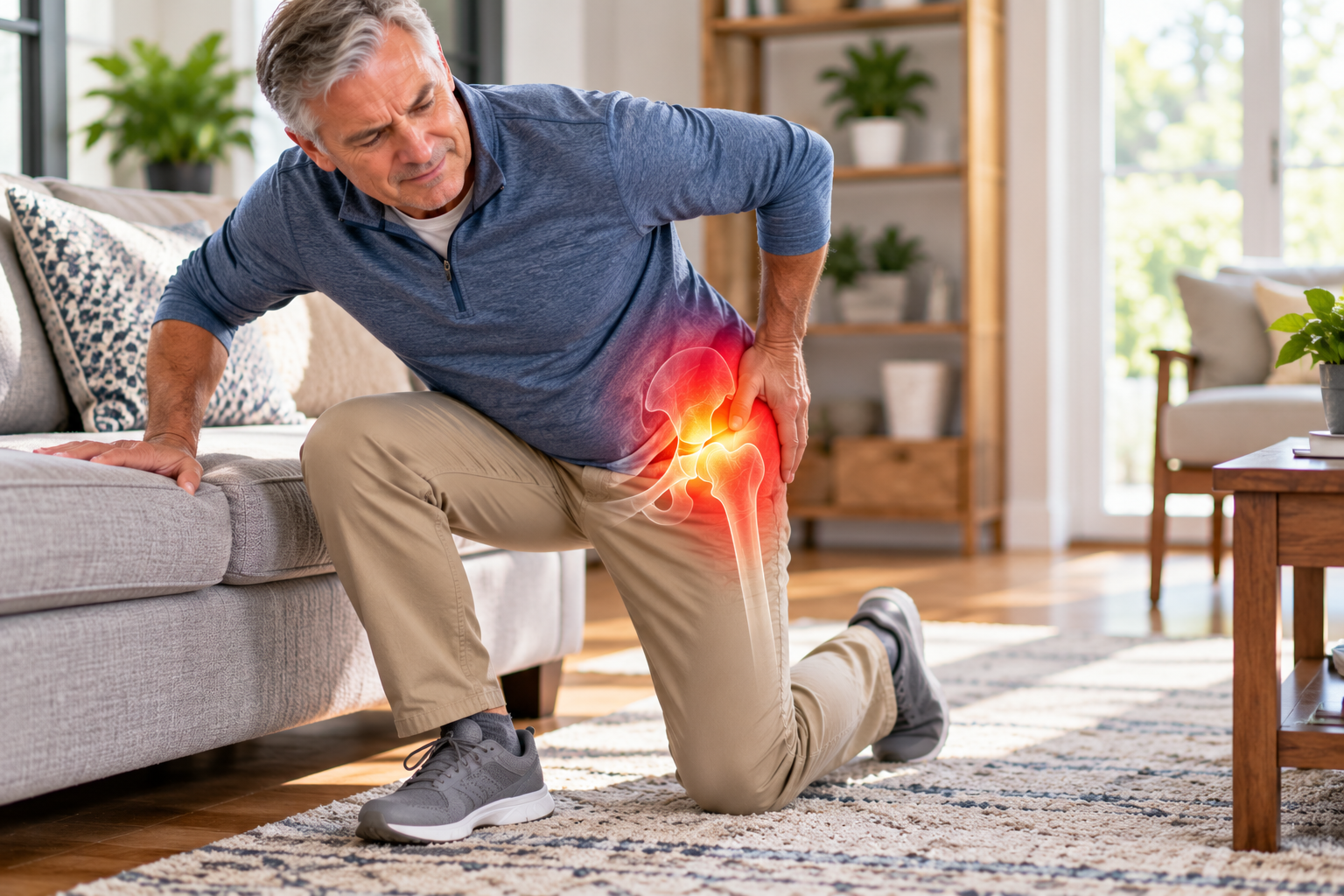
You get down on the floor to play with your grandchildren, pick something up or work on a project around the house.
Getting down isn't too difficult.
But when it's time to stand back up, your hip suddenly reminds you that you're not as comfortable as you used to be.
Maybe you need to roll onto your hands and knees. Maybe you reach for the couch or a nearby chair. Or perhaps you avoid getting on the floor altogether because you know how difficult getting back up will be.
Sound familiar?
Getting up from the floor requires a surprising combination of hip mobility, muscle strength and balance. When one of those isn't functioning comfortably, a simple everyday movement can become a real challenge.
Think about the difference between standing up from a chair and standing up from the floor.
When you're sitting in a chair, your hips and knees are already positioned relatively close to where they need to be for standing.
Getting up from the floor is different.
You may need to bend your hip deeply, rotate your leg, move into a kneeling position and then push yourself upward.
If your hip is stiff or painful, those movements can become uncomfortable.
You might notice difficulty when:
For some people, the problem isn't simply pain. It's that their hip no longer moves as freely as it once did.
Hip arthritis can cause pain, stiffness and reduced range of motion.
As the joint becomes less mobile, movements involving deep bending or rotation may become increasingly uncomfortable.
You might feel pain in your groin, the front of your hip, your buttock or your upper thigh.
Some people even experience pain that seems to travel toward the knee.
When getting up from the floor, your hip must move through several positions while supporting an increasing amount of your body weight.
That combination can make existing arthritis symptoms more noticeable.
But difficulty getting up from the floor doesn't automatically mean you have severe arthritis or need a hip replacement.
Your hip muscles are essential for standing up.
The gluteal muscles help extend your hip and lift your body as you rise.
Other muscles around the hip help stabilize your pelvis and maintain your balance.
If those muscles have become weak or painful, getting up from a low position may require considerably more effort.
You may find yourself pushing heavily through your arms or relying on nearby furniture.
Sometimes people assume these changes are simply part of getting older.
But muscle weakness, reduced activity and painful joints can all contribute to declining strength.
Have you noticed yourself automatically looking for a chair, couch or countertop whenever you get down on the floor?
You're not alone.
Many people gradually develop strategies to compensate for painful or stiff hips.
You might:
🪑 Pull yourself up using a chair
🤚 Push against the floor with both hands
🦵 Put your stronger leg forward first
🔄 Roll onto your hands and knees before standing
🚫 Avoid sitting on the floor entirely
Using support isn't necessarily a bad thing. In fact, having something sturdy nearby can make getting up safer.
However, if you increasingly depend on furniture because of hip pain or weakness, it's worth understanding what's contributing to the problem.
Absolutely.
Not every painful hip has arthritis.
Pain along the outside of the hip may involve irritated gluteal tendons or greater trochanteric pain syndrome.
Muscle weakness, reduced flexibility and balance problems can also make floor-to-standing movements difficult.
Sometimes the problem originates in the lower back.
Lumbar spine conditions may cause discomfort that travels into the buttock or hip area, occasionally accompanied by tingling, numbness or weakness.
And don't forget the knees.
Getting up from the floor requires substantial knee movement and strength. Sometimes what feels like a hip problem actually involves several joints working together.
Gravity helps lower your body toward the floor.
But standing back up requires your muscles to generate enough force to lift your body against gravity.
Your hips, knees and core muscles must work together while you maintain your balance.
That's why some people can get down onto the floor relatively comfortably but struggle considerably when trying to stand.
You may also notice similar difficulty with:
🪑 Rising from low furniture
🚗 Getting out of a low vehicle
🪜 Climbing stairs
🌱 Standing after gardening
🛁 Getting out of the bathtub
These activities place overlapping demands on your hips and surrounding muscles.
If getting up from the floor has become uncomfortable, consider modifying how you perform the movement.
When possible, use a sturdy chair or other stable support.
Rather than trying to stand directly from a seated position on the floor, you may find it easier to move onto your hands and knees, bring one foot forward and use your legs and arms to help yourself rise.
Avoid forcing your hip into positions that produce sharp pain.
Appropriate strengthening and mobility exercises may also help, depending on the underlying cause.
If you're having significant difficulty balancing or have fallen recently, a physical therapist can help you practice safer ways to get up.
No.
Difficulty getting up from the floor doesn't automatically mean you need hip replacement surgery.
Hip arthritis, muscle weakness, tendon problems, reduced mobility and other conditions can all contribute.
The appropriate treatment depends on the cause of your symptoms, how much function you've lost and your overall health.
For some patients, non-surgical treatment options may help reduce pain and improve mobility.
For others with advanced arthritis and significant limitations despite appropriate conservative care, hip replacement may eventually be worth considering.
The goal is to understand your condition and make an informed treatment decision.
Consider an evaluation if you're experiencing:
🚩 Increasing difficulty getting up from the floor
🚩 Persistent groin or hip pain
🚩 A noticeable limp
🚩 Reduced hip mobility
🚩 Difficulty climbing stairs
🚩 Pain that interferes with everyday activities
🚩 Increasing reliance on furniture or other people to stand
Sudden severe hip pain after a fall, particularly if you're unable to bear weight, warrants prompt medical evaluation.
Getting up from the floor may seem like a simple movement, but it requires substantial hip mobility, strength and balance.
If you've started avoiding the floor because you're worried about getting back up, pay attention to that change.
Hip arthritis, irritated tendons, muscle weakness and other conditions may be contributing.
At Arthritis & Joint Pain Center, we help appropriate patients with chronic hip pain understand what's contributing to their symptoms and explore non-surgical treatment options, with the goal of reducing pain and improving mobility.
Because playing with your grandchildren, gardening or working around the house shouldn't leave you wondering how you're going to stand back up.