If your hips feel stiff, tight, or painful when you stand up after sitting n the car, at work, on the couch, or at the table you’re not alone.
This is one of the most common early signs of hip inflammation and mobility loss in adults over 50.
You’re not “just getting older.”
Your hips are signaling that something inside the joint needs attention.
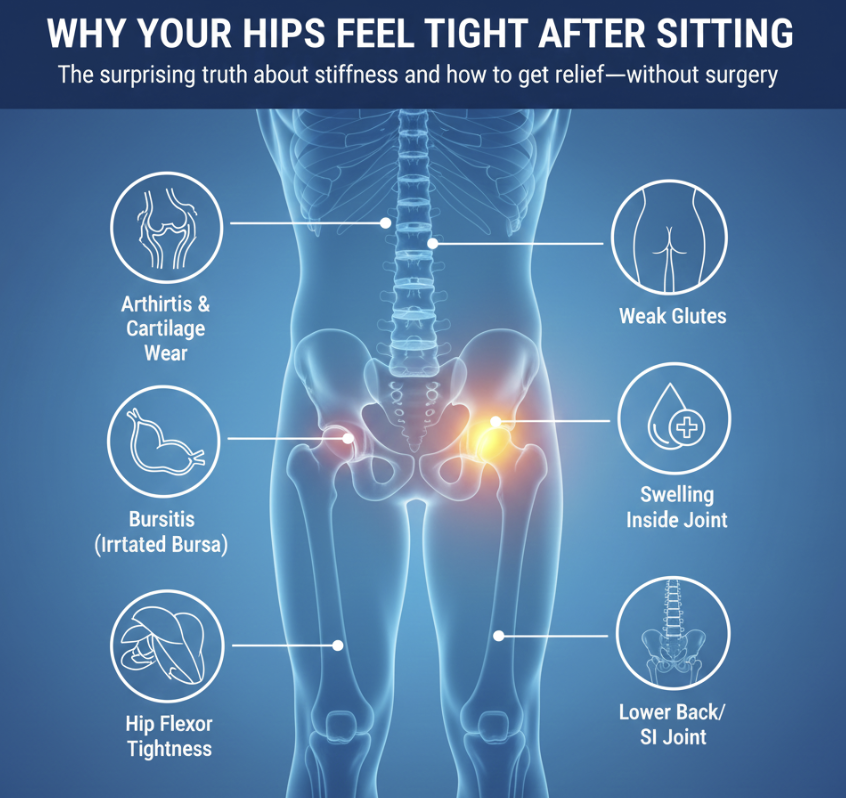
When the hip joint becomes inflamed or irritated, being still allows stiffness to settle in.
Standing up then triggers tightness or sharp pain.
Sitting shortens the hip flexors.
When you stand, they pull on the joint, creating tightness or a “locked” feeling.
An inflamed bursa becomes more sensitive after sitting, especially on harder chairs.
Weak stabilizers force the hip joint to take more load, especially when rising from a chair.
Sitting for long periods reduces circulation.
This allows inflammation to build up, causing stiffness.
Sometimes the hip feels tight, but the source is actually nearby joints.
Most people say the same thing:
“Once I start moving, it loosens up.”
This happens because motion:
But if the hips continue tightening after every period of sitting, the underlying issue will worsen without treatment.
✔ pain or stiffness lasting more than 10–15 minutes
✔ tightness returning every time you sit
✔ difficulty straightening up
✔ pain walking or climbing stairs
✔ hip catching, popping, or clicking
✔ discomfort sleeping on that side
These are signs of inflammation or early arthritis, not just flexibility problems.
❌ Stretching aggressively (often makes it worse)
❌ Blaming age and doing nothing
❌ Relying on heat without movement
❌ Sitting too long without changing positions
❌ Ignoring tightness until it becomes pain
Early intervention makes all the difference.
Our non-surgical treatments are designed to:
Most patients notice:
And all without surgery or cortisone injections.
✔ Stand up every 30–40 minutes
✔ Do gentle hip circles before standing
✔ Stretch hip flexors lightly
✔ Strengthen glutes with simple exercises
✔ Use a pillow behind your lower back when sitting
✔ Avoid crossing your legs for long periods
Small changes add up quickly.
If your hips stiffen every time you sit, it’s a sign your joint needs support and the sooner you address it, the easier it is to correct.