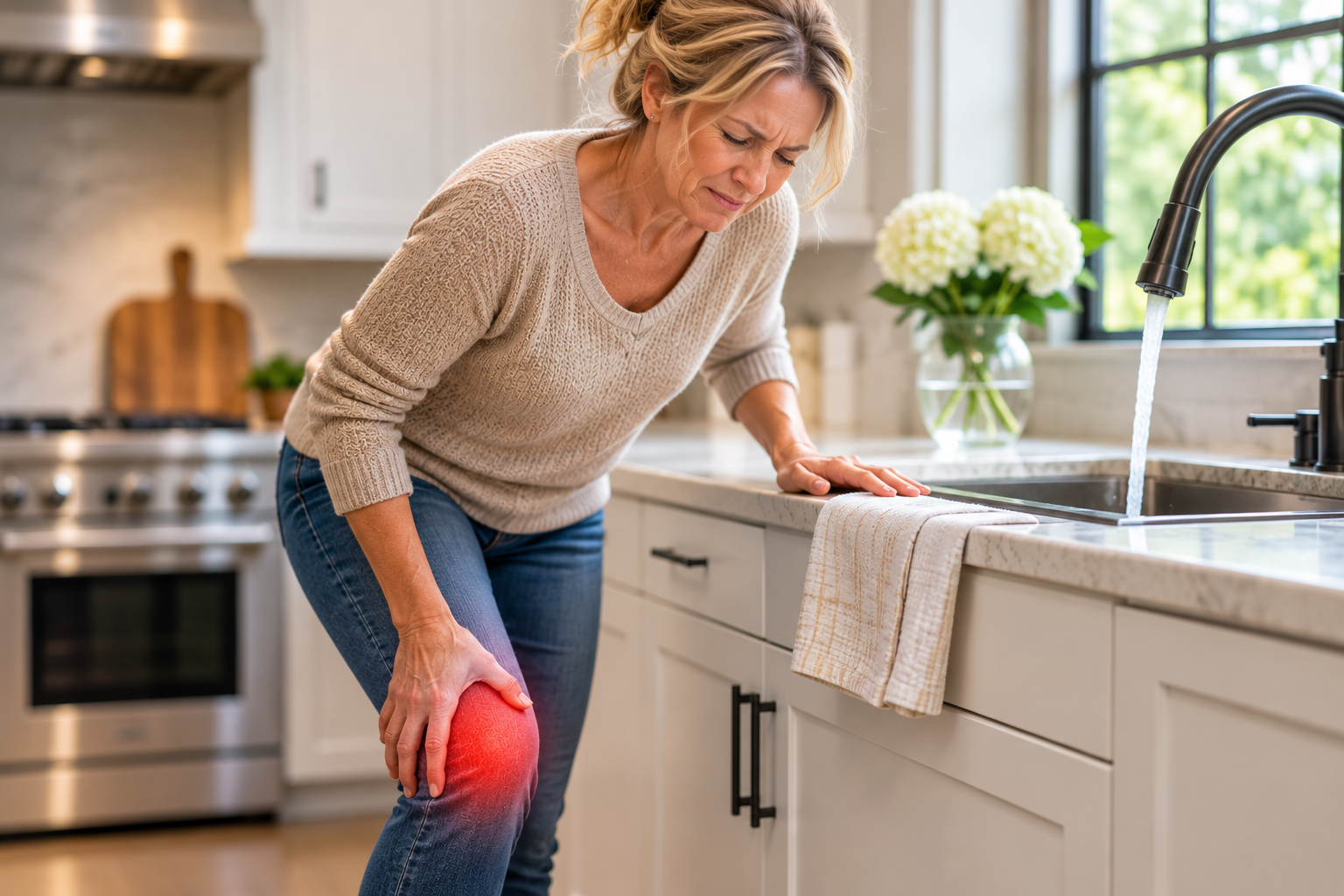
You're standing at the kitchen sink washing dishes, preparing vegetables, or cleaning up after dinner.
At first, everything feels fine.
But after 10 or 15 minutes, your knee begins to ache. Maybe you notice pressure along the inside of the joint, stiffness behind your kneecap, or a dull discomfort that gradually becomes more noticeable.
You shift your weight from one leg to the other. You lean against the counter or find yourself looking for a chair.
Interestingly, walking around may feel more comfortable than standing in one place.
If your knee hurts when standing at the kitchen sink, the problem may involve osteoarthritis, cartilage degeneration, muscle fatigue, joint inflammation, or changes in the way your knee supports your body weight.
For adults over 50, knee pain during prolonged standing can be an early sign of an underlying joint condition.
Understanding why standing still causes discomfort can help you recognize when an evaluation may be appropriate.
Many people assume that standing should be easier on their knees than walking because they're not moving.
However, prolonged standing places continuous demands on the knee joint and surrounding muscles.
When you're standing at the kitchen sink, several things happen:
During walking, your muscles alternate between contraction and relaxation, and the forces acting on your joints continually change.
Standing still provides fewer opportunities to vary the position and loading of the knee.
For individuals with arthritis or other musculoskeletal conditions, this sustained loading can gradually increase discomfort.
Here are seven possible explanations.
Knee osteoarthritis is one of the most common causes of chronic knee pain among older adults.
Osteoarthritis involves degenerative changes affecting the articular cartilage, subchondral bone, synovium, and other structures within the knee.
As these changes progress, the joint may become more sensitive to sustained weight-bearing.
Standing at the kitchen sink for 15 or 20 minutes may produce discomfort even when walking short distances remains manageable.
Common symptoms of knee osteoarthritis include:
Some individuals experience relatively mild symptoms during movement but notice a gradual increase in discomfort when remaining in one position.
This may reflect sustained joint loading, muscle fatigue, and underlying degenerative changes.
The knee contains three primary compartments: the medial tibiofemoral compartment, lateral tibiofemoral compartment, and patellofemoral compartment.
The medial compartment is located along the inside of the knee.
This region is commonly affected by osteoarthritis.
As cartilage degeneration progresses, patients may experience pain concentrated along the inner joint line.
Standing for extended periods can aggravate symptoms because the medial compartment frequently carries a substantial portion of the load transmitted through the knee.
Some individuals also develop a bowlegged alignment, medically known as genu varum.
This alignment can increase the proportion of load passing through the medial compartment.
Common signs include:
However, pain location alone cannot confirm medial compartment arthritis. Meniscus disorders and other conditions may produce similar symptoms.
The patellofemoral joint is where the kneecap articulates with the femur.
This joint plays an important role in transmitting force from the quadriceps muscles during knee movement.
Patellofemoral osteoarthritis involves degenerative changes affecting the cartilage beneath the kneecap and the corresponding surface of the femur.
Patients commonly experience pain during activities such as climbing stairs, squatting, and standing from low chairs.
However, prolonged standing may also produce discomfort, particularly when a person maintains a slightly bent-knee posture.
Some individuals notice pressure behind the kneecap or a dull ache toward the front of the knee.
Others experience grinding or stiffness when they begin moving after standing still.
Patellofemoral symptoms can overlap with tibiofemoral osteoarthritis, and both conditions may occur together.
Your quadriceps muscles help stabilize the knee during standing and walking.
Although standing requires less muscular effort than many other activities, maintaining a stable posture still involves continuous low-level muscle activity.
For individuals with reduced quadriceps strength or endurance, prolonged standing may become uncomfortable.
This is particularly relevant among older adults who have reduced their physical activity because of chronic knee pain.
Unfortunately, inactivity can contribute to further muscle weakness.
As the quadriceps become less capable of supporting the knee efficiently, everyday activities may require greater effort.
Some individuals notice that their knees begin aching after standing for several minutes, even though they can walk short distances without substantial difficulty.
Appropriate strengthening exercises may improve muscle endurance and knee function.
Some patients with advanced osteoarthritis are told they have bone-on-bone arthritis.
This term generally describes severe joint-space narrowing associated with substantial cartilage loss.
When advanced degenerative changes are present, the knee may have reduced tolerance for sustained weight-bearing.
Standing at the kitchen sink, waiting in line at a store, or attending a social gathering may become increasingly uncomfortable.
Patients may experience deep aching, stiffness, swelling, or difficulty remaining on their feet.
However, the severity of degenerative changes visible on an X-ray does not always correspond directly with symptom severity.
Having bone-on-bone knee arthritis does not automatically mean immediate knee replacement surgery is required.
Treatment decisions should consider pain, mobility limitations, overall health, and response to appropriate conservative management.
The knee contains a synovial membrane that produces fluid to lubricate the joint.
When this membrane becomes inflamed, the condition is called synovitis.
Synovitis can occur with osteoarthritis, inflammatory arthritis, and other joint disorders.
Inflammation may contribute to swelling, stiffness, warmth, and increased sensitivity to movement or weight-bearing.
Some individuals notice that their knee becomes more uncomfortable after prolonged standing, particularly when swelling is present.
Others experience a sensation of pressure or fullness within the joint.
However, a persistently swollen knee should not automatically be attributed to osteoarthritis.
Other conditions, including crystal-associated arthritis and inflammatory joint disease, may require different treatment.
A suddenly hot, severely swollen knee, particularly with fever, requires urgent medical evaluation to exclude joint infection.
The way your body distributes weight through your knees can influence discomfort during prolonged standing.
For example, individuals with bowlegged or knock-kneed alignment may place relatively greater loads on specific regions of the joint.
Previous injuries, muscle weakness, foot mechanics, and hip control can also affect lower-extremity loading.
When standing at the kitchen sink, some people unconsciously shift most of their weight onto one leg.
Others lock their knees into full extension or maintain a slightly flexed posture.
These habits may contribute to muscle fatigue or aggravate an already sensitive joint.
However, no single standing posture is universally harmful.
The goal is to maintain comfortable movement and avoid remaining in positions that consistently reproduce symptoms.
The location of discomfort may provide clues about the underlying problem.
Pain location
Possible contributing conditions
Inside of knee
Medial compartment osteoarthritis, medial meniscus problems
Outside of knee
Lateral compartment arthritis, lateral soft-tissue disorders
Front of knee
Patellofemoral arthritis, extensor mechanism irritation
Behind knee
Joint swelling, Baker's cyst, posterior soft-tissue problems
Deep throughout knee
Osteoarthritis, synovitis, or another intra-articular condition
Both knees after prolonged standing
Bilateral osteoarthritis, muscular fatigue, or other contributing factors
Pain location alone cannot establish a diagnosis because several knee conditions produce overlapping symptoms.
Some individuals notice an interesting pattern: standing still makes their knee ache, but walking around provides temporary relief.
There are several possible explanations.
Movement changes the distribution of forces acting on the joint.
It also allows muscles to alternate between contraction and relaxation rather than maintaining the same posture.
For individuals with osteoarthritis, gentle movement may help reduce stiffness associated with inactivity.
This does not mean walking always reduces knee pain.
In more advanced osteoarthritis, prolonged walking may also aggravate symptoms.
However, the difference between standing and walking can provide useful information during a clinical evaluation.
Several practical strategies may help make everyday kitchen activities more comfortable.
Avoid remaining completely stationary for long periods.
Taking a few steps, gently shifting your stance, or briefly sitting down may help reduce discomfort.
A cushioned, slip-resistant standing mat may improve comfort for some individuals.
However, mats should lie flat and remain securely positioned to reduce tripping hazards.
Some individuals habitually stand with their knees pushed into full extension.
Maintaining a comfortable, relaxed standing position may reduce discomfort.
You do not need to keep your knees bent continuously, which can increase quadriceps demand.
If you're preparing vegetables, peeling potatoes, or performing another prolonged kitchen activity, consider sitting on a stable stool or chair.
This can reduce the amount of time your knees must support your full body weight.
Appropriate strengthening can improve knee stability, endurance, and overall function.
For individuals with knee osteoarthritis, progressive resistance exercise is an important component of conservative management.
Footwear can influence comfort during prolonged standing.
Shoes with appropriate cushioning and support may help some individuals tolerate standing activities.
However, footwear needs vary, and no particular shoe type reliably treats knee arthritis.
Instead of standing continuously for 30 minutes, consider alternating between standing, walking, and sitting.
This may help manage symptoms without requiring you to stop participating in everyday activities.
Occasional knee discomfort after prolonged activity does not necessarily indicate a serious joint problem.
However, recurring pain during everyday tasks deserves attention.
Consider scheduling an evaluation if you experience:
Seek prompt medical attention for sudden severe swelling, a hot or red knee, fever with joint pain, inability to bear weight, or significant symptoms following an injury.
These findings may indicate conditions requiring urgent care.
Not necessarily.
Many individuals with knee osteoarthritis, including some with advanced degenerative changes, can explore non-surgical management before considering joint replacement.
Depending on the diagnosis, conservative treatment may include physical therapy, therapeutic exercise, weight management when appropriate, activity modification, medications, and selected injection-based treatments.
The effectiveness of different treatments varies.
Non-surgical care cannot reliably regenerate cartilage lost through advanced osteoarthritis or guarantee that surgery will be avoided.
For patients experiencing severe pain and substantial functional limitations despite appropriate conservative management, knee replacement surgery may be a reasonable option.
An individualized evaluation can help determine the most appropriate next step.
If knee pain makes it difficult to stand at the kitchen sink, prepare meals, walk comfortably, or enjoy everyday activities, it may be time to explore your options.
At Arthritis & Joint Pain Center, we help appropriate patients experiencing chronic knee pain and osteoarthritis understand their condition and explore individualized non-surgical treatment options.
Whether your discomfort has recently developed or you've been living with knee arthritis for years, an evaluation may help clarify your next steps.